FREE / NO REAL MONEY
Keno Odds Calculator: 40 Numbers, 10 Draws
Select up to ten numbers, draw ten unique results and inspect exact hit probabilities. The payouts are model-generated and do not represent a casino paytable.
How it works & examplesUnderstand the calculation
Keno probabilities depend on how many numbers you select
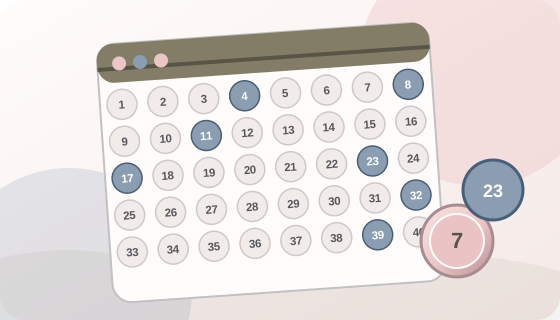
The board contains 40 numbers and each simulated draw selects 10 distinct numbers. Selecting one number gives a 10/40, or 25%, chance of one match. With several selections, the probabilities of zero, one or more matches must account for drawing without replacement; they are not independent coin flips.
Counting Keno matches is different from a streak of safe reveals; compare that second sampling problem in Mines Calculator: Odds, Multipliers and Virtual Play.
Read the payout table together with the match probabilities. A high multiplier for a rare match count can contribute less to average return than a small multiplier for a common count. The table is an educational model, not a universal casino Keno table. Selecting more numbers changes the distribution of matches and rewards, not your ability to know the next draw.
Play with virtual credits
Pick 1–10 numbers on a 40-number grid, draw 10 balls, calculate hypergeometric hit odds and test model multipliers with virtual credits.
Try the simulator below. Input values stay in your browser; no account or money is involved.
Model assumptions: No. Virtual games use declared teaching models. Verify any actual operator’s payout rules independently.
Related interactive tools
- Mines Calculator: Safe-Tile Odds and Virtual Play
Calculate exact Mines survival probability, test safe picks on a playable 25-tile board and compare model payouts using virtual credits.
- RTP & House Edge Calculator: Expected Session Cost
Calculate house edge, total turnover, expected gross return and expected loss from a stated RTP, a stake per round and number of rounds.
- Bonus Wagering Requirements Calculator
Calculate wagering turnover from bonus base, contribution rate, x multiplier and assumed house edge; compare actual expected cost.
- Plinko Simulator: Landing Probabilities and Demo
Drop animated Plinko balls, select risk and rows, inspect binomial landing probabilities and run 100 or 1,000 virtual trials.
How to use the tool
Calculate exact match-count odds in one specific Keno variant: 40 numbers, 10 drawn, up to 10 selected.
- Mark 1–10 distinct numbers on the forty-number board.
- Draw ten unique balls or run a sample to compare match counts.
- Read the hypergeometric distribution before interpreting the synthetic multipliers.
Understanding your result
If you select only one number, it appears in the ten-ball draw with probability 10/40 = 25%. More selected numbers change the full distribution, not the number of balls drawn.
Scope and limitations
This is a 40/10 model, not 80-number lottery Keno. The payout curve is normalized to 94% teaching RTP and is not an operator paytable.
Before you rely on the result
- How the calculation works
Formulas, assumptions, rounding and model limits are documented on the methodology page.
- Check the current inputs
Use the odds, RTP, fees, bonus terms or other values currently shown by the operator or market.
Keno probability: selected numbers, hits and payout variance
Keno is a without-replacement probability problem. If N numbers exist, D are drawn and you select S, the probability of exactly H hits follows the hypergeometric distribution: C(S,H) × C(N−S,D−H) / C(N,D).
Changing how many numbers you select changes the entire hit distribution. A payout table then assigns value to those hit counts; probability and payout must be analysed separately.
Why hit counts are not independent coin flips
Once a number is drawn it cannot be drawn again in the same round. That without-replacement structure is why a binomial approximation is not the exact Keno model. The calculator uses combinations for the supported 40/10 teaching variant.
More selected numbers create more possible hit counts
Selecting one number produces only zero or one hit. Selecting several numbers creates a wider distribution across zero, one, two and more hits. Whether that increases or decreases expected return depends on the payout table, not the hit count alone.
Model paytable versus operator Keno
Keno variants differ in board size, draw count, selectable spots, multipliers, jackpot rules and RTP. The simulator's synthetic payout table is educational and must not be presented as a quote or advertised RTP for a specific casino.
Worked example
In this 40-number variant, drawing ten unique balls gives a single selected number a 10/40 = 25% chance of appearing. Choosing more numbers changes the complete hit distribution, computed without replacement.
Are the payout multipliers from a real Keno game?
No. They are normalised to an illustrative 94% RTP. Actual Keno formats, hit tables and house edges vary by operator.
Questions about this calculation
Do repeated draws make my chosen numbers more likely?
No. Fresh draws sample ten distinct numbers from forty independently of earlier rounds.
Can I compare this with 80-number Keno?
Not directly: changing the pool, selected count or draw count changes the hypergeometric parameters and all match probabilities.
When is Keno Odds Calculator: 40 Numbers, 10 Draws the right tool?
Calculate exact match-count odds in one specific Keno variant: 40 numbers, 10 drawn, up to 10 selected.
How should I read the result from Keno Odds Calculator: 40 Numbers, 10 Draws?
If you select only one number, it appears in the ten-ball draw with probability 10/40 = 25%. More selected numbers change the full distribution, not the number of balls drawn.
What can Keno Odds Calculator: 40 Numbers, 10 Draws not tell me?
This is a 40/10 model, not 80-number lottery Keno. The payout curve is normalized to 94% teaching RTP and is not an operator paytable.